Public ledgers changed what an ordinary person can verify. Anyone can confirm that a specific amount moved from one address to another at a particular moment, without asking permission or trusting a statement. That is genuinely new, and it is also narrower than it sounds. The ledger records the transfer and stops there, leaving every human question, who controls the address and what they owe, exactly where it was before. Stake Lispro Neo sits precisely in that gap: the part of the story a user can prove is the part that helps them least.
What can be proved about Stake Lispro Neo?
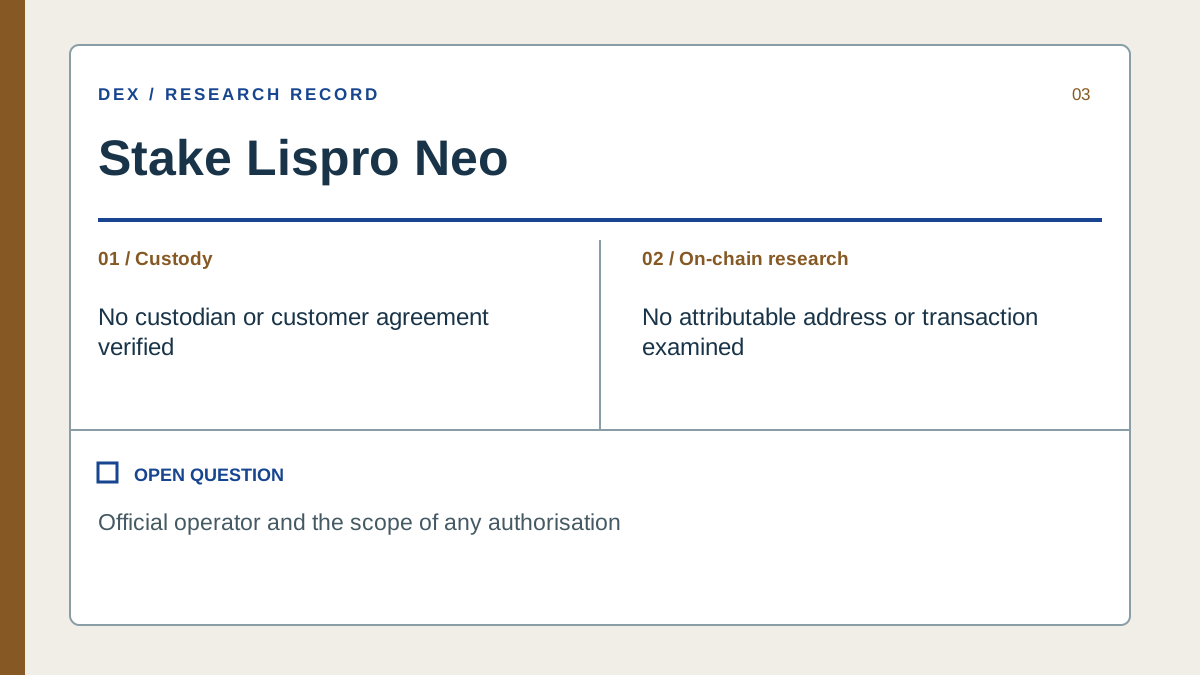
A trading and staking brand promoted online. The material available to us identifies neither the operator, nor a custodian, nor an address whose activity could be examined.
Pros
- Any transfer a user makes on a public chain leaves a permanent record they can keep
- No published regulator action naming this exact brand reached us before the checking date
The points above summarise what the operator says about its own platform. We have not verified them.
Cons
- Transfers in cryptocurrency are final, and no published policy governs their return
- Yield and staking language is used across this market without any defined underlying activity
- No named entity exists to receive a complaint or a legal claim
Custody: who holds the funds
In this corner of the market custody has a simple technical meaning and a complicated practical one. Whoever holds the private key controls the asset. A deposit sent to a platform address transfers control, and from that moment the user holds a claim, not a coin.
The claim is worth whatever the firm behind it is worth, which brings the question back to the same place every entry on this site arrives at: who is the firm. A platform running a genuine custody operation can say where keys are held, whether a qualified custodian is involved, and how client assets are separated from the operator's own. Some publish reserve attestations from a named accounting firm, which is not a full audit and is still far more than a slogan.
We found no statement of any of that kind for this brand.
What proof of reserves does and does not show
A reserve attestation shows assets at a moment in time under a stated methodology. It does not show liabilities unless the methodology includes them, it does not show borrowed assets moved in for the snapshot, and it does not bind anyone to solvency the following week. It is evidence rather than a guarantee, and it is worth asking for anyway, because the refusal is informative and the answer is checkable against a named firm.
Routing: where an order would go
Where a platform describes itself as decentralised, the claim should be testable, and this is one of the rare cases where testing is realistic. A genuinely on-chain venue leaves traces: contract addresses that anyone can inspect, transactions that settle publicly, and a code base somebody can read.
A platform that takes custody, quotes prices internally and settles in its own database is a centralised service whatever vocabulary surrounds it. Both models exist legitimately, and the way to tell them apart is to ask for an address or a contract to inspect. No such identifier reached us here, so execution stays unknown and the decentralised label, if used, remains untested.
The entity behind the terms
The vocabulary of this sector encourages the idea that entities are old fashioned. In practice every dispute a user may ever have needs a defendant with a name and an address.
Our search for the company behind Stake Lispro Neo found nothing we could confirm: no filing, no registration, no jurisdiction stated for a contract. The consequence is that an agreement to accept funds, if there is one, would exist between an identifiable person on one side and an unidentifiable party on the other.
The licence question
Rules for crypto asset service providers now exist in many jurisdictions and continue to develop, which has produced a distinctive kind of misleading claim. A firm registers for one narrow purpose, often anti money laundering supervision or payment services, and then advertises itself as regulated without saying for what.
The remedy is the same three field check used everywhere on this site, with one addition. Establish the authority, the reference number and the exact legal name, then read the scope of what was granted. Registration as a virtual asset service provider is not authorisation to manage money, to offer investment advice, or to promise a return. A licence covering one activity does not extend to another simply because the same company performs both.
For this entry there was no claim to test and no register match to report.
Deposits and withdrawals
Finality is the defining property of a crypto deposit. A card payment can be disputed within a scheme's rules, a bank transfer can occasionally be recalled, and a transfer on a public chain cannot be undone by anybody, including the person who sent it. That property is a feature of the technology and a serious hazard in the hands of a platform that has published no withdrawal terms.
Two habits reduce exposure without requiring any technical skill. The first is a test transfer of a trivial amount followed by a withdrawal of it, done before anything meaningful is sent. The second is a record kept outside the platform: the addresses used, the hashes, the dates and the exact wording of any promise made about returns. If a dispute follows, that file is the case.
Reading the marketing
Yield is the word doing most of the work in promotions of this type, and it is doing it in the absence of a source. Where a return comes from is a question with a small number of legitimate answers: protocol rewards for securing a network, interest paid by borrowers, market making spreads, or fees from a service. Each of those can be described, and each carries risk that can be explained.
A page offering a fixed percentage with no source named is not describing an investment, it is describing a feeling of one. The second device to watch is the appeal to inevitability, where the technology is presented as certain to appreciate and the only remaining decision is how fast to act. Markets do not distribute certainty, and a promotion that does is selling something else.
A checklist before you fund an account
- Ask which legal entity operates the service and where it is registered, and get the answer in writing.
- Ask where a return comes from, in one sentence, and treat a non answer as the answer.
- Request an address, a contract or an attestation that can be inspected independently.
- Send a trivial test amount and withdraw it before committing anything you would miss.
- Keep hashes, addresses and correspondence outside the platform, in a place you control.
This is a short list because the leverage in it is concentrated at the top. Steps one and two are conversations, they cost nothing, and in this category they end most decisions before a transfer is ever made.
Frequently asked questions
Does a transaction hash prove my deposit is safe?
It proves the transfer left your wallet and arrived at an address, with a timestamp nobody can alter. It proves nothing about who controls the receiving address, what they intend to do, or whether any obligation to return the funds exists. Those questions live off the chain, in contracts and company records.
What does staking mean when a platform offers it?
On a proof of stake network, staking means committing tokens to help secure the network in return for protocol rewards, and the activity is visible on chain. When a platform offers a fixed return without identifying the network, the validator or the addresses involved, the word is being used as a yield label rather than as a description of anything verifiable.
I sent crypto and now cannot withdraw. What are my options?
Preserve everything first: transaction hashes, addresses, screenshots and all correspondence. Report the matter to the police or the fraud reporting body in your country, and to the exchange you bought from if the transfer passed through one. Be cautious of recovery services that ask for payment up front, because a second loss on top of the first is a common outcome.