Entry

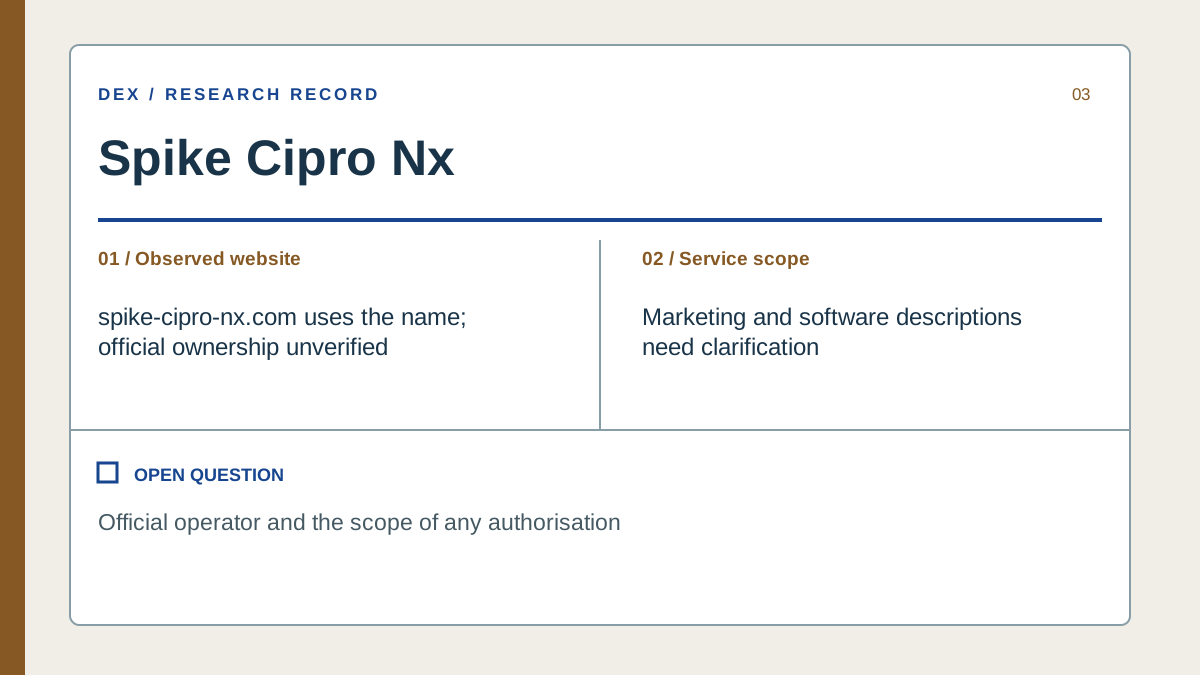
Spike Cipro Nx: a brand, a template and no named operator

Spike Cipro Nx discloses no custodian, no venue and no operating company. Read what a white label platform changes and how to verify a licence claim.

Author Colm Barrenger
Published
Last verified

How we make money. We earn a commission on some links on this page. Payment never changes a verdict: platforms carrying regulator warnings are marked as such whether or not they pay us.

What the numbers here are. Win rates, success rates, fees and minimum deposits quoted on this page come from the operator’s own marketing unless we name a register or a regulator’s document as the source. We have not tested any of them and found no independent audit of them.

In this article
  1. Custody: who holds the funds
  2. Routing: where an order would go
  3. The entity behind the terms
  4. The licence question
  5. Deposits and withdrawals
  6. Reading the marketing
  7. A checklist before you fund an account
  8. Frequently asked questions

An interface proves less than people expect. Charting, order tickets, account tiers and a mobile view are all available to anyone willing to license a platform from a vendor and put a new name on top, and that arrangement is perfectly ordinary in this industry. What it never supplies is a firm willing to owe you money. Spike Cipro Nx presents the first half and, in everything that reached our desk, not the second.

Who stands behind Spike Cipro Nx?

A trading brand promoted online. The available material describes a service without naming the business providing it or the institution that would hold client funds.

Application CategoryFinancial Application
Operating SystemWeb

Pros

  • The brand can be searched in public registers in about a minute
  • No published regulator document naming this exact brand reached us before the checking date

The points above summarise what the operator says about its own platform. We have not verified them.

Cons

  • Responsibility for deposits is not assigned to any identifiable firm
  • No withdrawal terms are published in advance of payment
  • Complaint routes depend on a named regulated entity, and none is named

Custody: who holds the funds

Separate the software layer from the money layer and most of the confusion in this market disappears. The software layer can be rented. The money layer is a set of legal relationships that cannot be, because somebody has to accept the obligation to return funds.

A firm that has done that work will name the institution where client money rests, state whether the account is held for clients or pooled, and identify any compensation arrangement covering a failure. Those statements are short and they are either present or they are not.

For this brand they are not. That leaves a deposit in the position of a payment rather than a placement: money that has been sent somewhere, with no documented obligation attached to its return.

Two questions that separate the layers

Ask a platform who provides its trading software, and then ask which company holds client funds. The first question is usually answered readily, because vendor relationships are commercial and unembarrassing. The second is the one that produces either a name or a deflection, and the deflection is the answer worth recording.

Routing: where an order would go

Rebranded platforms can be wired to genuine liquidity, to an internal dealing desk, or to nothing at all. The same screens serve all three, which is exactly why the screens cannot be used as evidence.

What distinguishes the arrangements is documentation. An execution policy names the venues or the counterparty type and explains how the best available terms are pursued. A conflicts policy explains what happens when the firm profits from a client's loss. Neither document is exotic, and a platform that cannot produce either has not made its model available for examination.

Nothing of this kind is published for Spike Cipro Nx, so we record execution as unknown rather than guessing at a model.

The entity behind the terms

Registry work reduces to one instruction: find the legal person. The brand is a label, the website is a marketing asset, the software is a licensed product, and the only thing that can hold an obligation is a company with a registration.

Our search did not produce one for this brand. No company name, number, registered office or governing jurisdiction that we could confirm. As always we distinguish between what does not exist and what we could not find, and the practical consequence stays identical either way. A user can neither verify their counterparty in advance nor identify it afterwards.

The licence question

There is a version of due diligence that consists of typing a brand into a search engine and reading the first page of results. It is better than nothing and it is not the check.

The check uses the registers. Take the legal name from the terms, search the regulator named in the claim, and read three things in the record that comes back: the exact name, the permissions, and the current status with its date. A permission for payment services is not a permission to run investment business. A lapsed authorisation is not an authorisation. A record for a similarly named company is a coincidence until the numbers match.

We had no legal name to search for this entry, and searching the brand itself returned nothing in the registers we use.

Deposits and withdrawals

Money going out is the only real test of a trading account, and the terms governing it should be readable before money goes in. A published policy covers minimum amounts, fees, the documents required for identity checks, the point at which those documents are requested, and the timeline the firm holds itself to.

None of that is available here in advance. The habits that protect a user in that situation are unglamorous: use the most reversible payment method available, keep the amount small enough that the lesson is affordable, request a withdrawal early rather than after a period of apparent growth, and never send additional money to release funds already held. That last pattern, a fee or tax demanded at the exit, is one of the more reliable markers of a relationship that will not end well.

Reading the marketing

Three lines recur in promotions for brands of this shape, and each rewards a moment of translation.

"Advanced algorithms" is a claim about mechanism with no mechanism disclosed; the translatable version would name what the system trades, how often, and with what measured result over a stated period. "Trusted by thousands of users" is an assertion about a population no outsider can count. "Regulated and secure" is two claims joined by a conjunction, one of which can be checked in sixty seconds and usually is not.

The useful discipline is to delete every sentence that cannot be falsified and read what remains. On most pages of this kind, very little does.

A checklist before you fund an account

  1. Ask, in writing, which company will hold your money, and get a registration number.
  2. Search that number in the relevant company register and in any regulator register being claimed.
  3. Request the execution policy, the conflicts policy and the withdrawal policy as documents.
  4. Confirm whether the website is the broker or an introducer to someone else.
  5. Deposit a small amount reversibly, then withdraw most of it before doing anything further.

The reason this list starts with a written question is that written answers can be checked later, and a platform that will not put the name of its own custodian in writing has given you your answer in the most useful form available.

Frequently asked questions

Is it a problem that the software might be licensed from a vendor?

No, and it is worth saying clearly. Most retail platforms in this market run on software built by specialist vendors, and rebranding it is ordinary business. The problem arises when the vendor relationship is offered in place of an answer about who holds client money, because those are unrelated questions.

How can I tell whether a website is a broker or an introducer?

Read the contract you are asked to accept. An introducer passes your details to another firm, and the account, the money and the obligations then belong to that firm. If the terms do not say which role the website plays, ask in writing before paying anything.

What would make this entry stronger either way?

A named company traceable in a register, a published custody statement, or a supervisory document mentioning the brand. Each would be added here with its source and the date we saw it, and the verdict would move accordingly.

Check it yourself

These registers are public and free. If a platform claims a licence you cannot find here, treat the claim as false.

Written by

Payments and withdrawal flows

Colm Barrenger follows the money path: which payment methods a platform accepts, what that choice implies about reversibility, and how a withdrawal request is supposed to travel back to the person who made the deposit. He writes the deposit and withdrawal sections of DEX Registry entries and the practical checklists at the end of them.