Entry

Spike 500 Amrix: the number in the name and the leverage behind it

A registry entry on Spike 500 Amrix: no named custodian, no disclosed venue, no identified company, and what leverage means when nothing is documented.

Author Teodora Vlasak
Published
Last verified

How we make money. We earn a commission on some links on this page. Payment never changes a verdict: platforms carrying regulator warnings are marked as such whether or not they pay us.

What the numbers here are. Win rates, success rates, fees and minimum deposits quoted on this page come from the operator’s own marketing unless we name a register or a regulator’s document as the source. We have not tested any of them and found no independent audit of them.

In this article
  1. Custody: who holds the funds
  2. Routing: where an order would go
  3. The entity behind the terms
  4. The licence question
  5. Deposits and withdrawals
  6. Reading the marketing
  7. A checklist before you fund an account
  8. Frequently asked questions

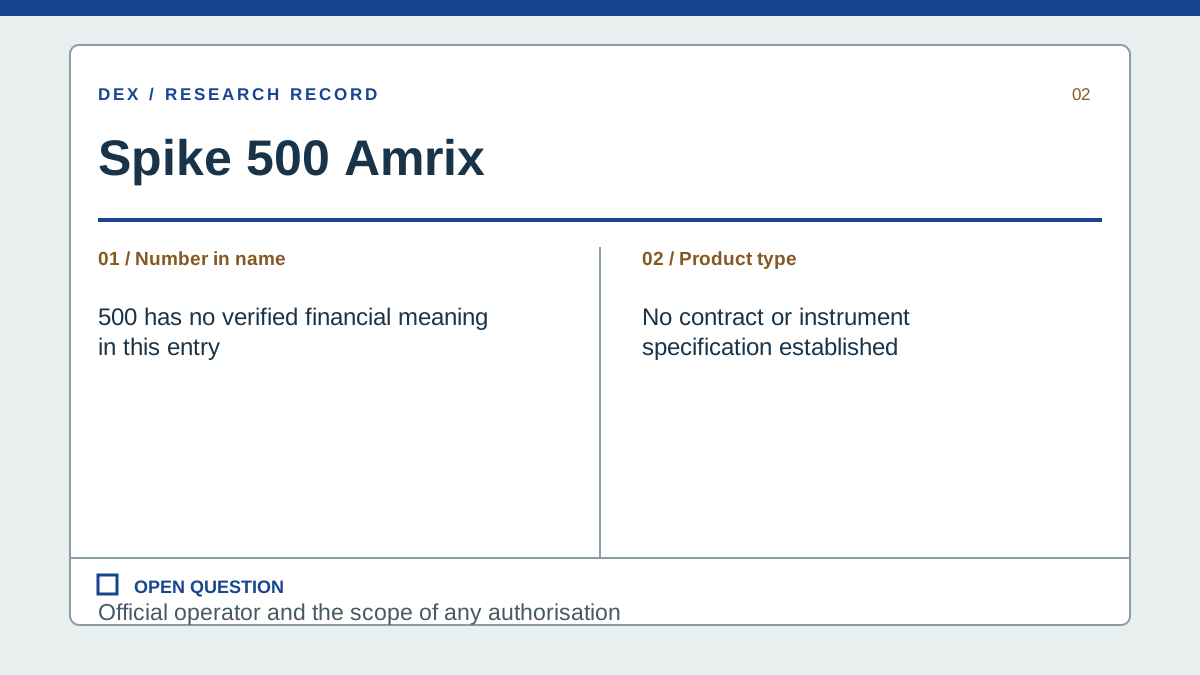
A numeral inside a brand name is a promise with no grammar. It suggests a multiplier, a tier, a capacity, a version, and it commits to none of them. Spike 500 Amrix carries one, and the first thing a registry has to establish is whether any document defines it. None that reached us does, which leaves a figure that reads like a specification and functions like an adjective. The rest of this entry deals with the questions a numeral cannot answer.

What is Spike 500 Amrix offering, in structural terms?

A trading brand circulated online under a name that includes a numeral. The material we reviewed does not define the numeral, identify the operator or describe how positions would be opened.

Application CategoryFinancial Application
Operating SystemWeb

Pros

  • The brand is distinctive enough to search in a register, and that search costs nothing
  • We recorded no published supervisory action naming this brand before the checking date

The points above summarise what the operator says about its own platform. We have not verified them.

Cons

  • No margin or liquidation terms are published, so the conditions for losing a position are undefined
  • No custodian is identified, leaving the deposit without a documented holder
  • No named company means no forum in which to bring a complaint

Custody: who holds the funds

Leveraged products make the custody question sharper rather than softer, because margin is money the operator can consume on your behalf while you watch. The rules around how and when that happens are supposed to be written, and the money supporting it is supposed to sit somewhere identifiable.

An authorised firm answers with specifics: an institution holding client money, an account structure keeping it apart from the firm's own funds, a reconciliation cycle, and a compensation scheme where one applies. Those four facts are dull, checkable and rarely disputed by firms that have them.

Our research produced none of them for this brand, and the absence carries further here than it would for a simple spot product. A user is asked to post margin without a written definition of what would take it.

Margin, liquidation and the terms that matter

Three clauses decide the fate of a leveraged account: the margin requirement, the level at which positions are closed automatically, and the treatment of negative balances if a market gaps through the close. A trader who cannot quote those three numbers from a contract does not know what they are exposed to. We could not locate a contract for this brand containing them.

Routing: where an order would go

Leveraged retail trading is usually a contract between the user and the firm rather than a purchase in a market. That is a legitimate model, widely licensed and heavily regulated, and firms that run it publish the fact together with the conflicts it creates.

The conflict is not subtle. If the firm is your counterparty, your loss is its revenue, and supervisors respond by demanding disclosure, conduct rules and capital. All of that structure rests on knowing which model applies. For Spike 500 Amrix the model is unstated, so the user cannot tell whether they are trading with a market, with the operator, or with a screen.

The entity behind the terms

A registry entry becomes substantial at the moment a company can be named. Ours did not.

We searched for a contracting company connected to this brand and found no filing, registration or corporate record we could tie to it. Stated carefully: this is the result of our research, not a proof of absence. But the reader's position is unchanged by that caution. An unnameable counterparty cannot be checked for history, cannot be served with a complaint, and cannot be identified to a bank as the recipient of a disputed payment.

The licence question

Register work rewards precision and punishes speed. The search that matters uses the legal name from the terms of service, and the result that matters is a returned record whose name matches that string exactly.

Two further details are worth reading in any record that does come back. The first is the permission set, since a firm may be authorised for payments, credit or insurance mediation and not for the leveraged products being sold. The second is the status and date, because authorisations are withdrawn, lapse and change hands, and a screenshot from an old marketing page proves nothing about today.

For this entry there was nothing to read. No claim with a regulator, number and legal name reached us, and our searches of the public registers returned no match for the brand.

Deposits and withdrawals

With leveraged accounts the withdrawal question acquires an extra layer, because a balance is not necessarily withdrawable while positions remain open. Genuine platforms explain the difference between equity, free margin and withdrawable funds, and the explanation appears in the terms rather than in a chat window.

Nothing of that kind is published here. The generic protections therefore apply in full. Prefer a reversible payment method for a first deposit. Read the fee schedule before rather than after. Treat any demand for a payment in order to release a withdrawal as the end of the relationship rather than a step in it, and take the question to your bank instead.

Reading the marketing

Promotional material for leveraged brands tends to describe profit as a feature of the product and loss as a failure of the user. The grammar gives it away: gains happen automatically through the platform, losses happen to people who did not follow instructions.

The honest version of the same information is duller. Leverage increases the size of the position relative to the deposit, which increases both outcomes proportionally, and the deposit is finite while the market is not. A page that never states this plainly has made a decision about what its reader should not think about.

A second device to watch for is the demonstration account with impossible smoothness. Simulated equity curves cost nothing to generate and correspond to no trading history, and they are persuasive precisely because they are free of the thing real trading contains, which is drawdown.

A checklist before you fund an account

  1. Ask what the numeral in the brand name refers to and request the answer in writing.
  2. Obtain the margin requirement, the liquidation level and the negative balance policy from the contract.
  3. Identify the contracting company and search it in a register before transferring anything.
  4. Confirm which institution holds client money and whether the account is segregated.
  5. Withdraw early and small, and stop entirely if a new condition appears at that moment.

Where the first three steps cannot be completed, the product is not being sold to you on terms you can examine, and no amount of interface polish changes that.

Frequently asked questions

Does the number in the name mean leverage of that size?

Not unless a contract says so. Numerals in these brand names are marketing devices, and in this case we found no document connecting the figure to any leverage ratio, account tier or product feature. Read the leverage terms from the contract or assume they are unknown.

Why is high leverage described as risky rather than powerful?

Because it multiplies both directions of a price move against a deposit that is finite. A small adverse move can consume the margin supporting a position, at which point the position is closed and the money is gone. Regulators in several jurisdictions cap retail leverage for exactly this reason.

The brand shares a word with another entry on this site. Are they connected?

We do not know, and we will not say otherwise. A shared naming stem is a pattern we record because it helps readers who encounter one brand after another. Establishing common ownership would require corporate records, which in this case we do not have.

Check it yourself

These registers are public and free. If a platform claims a licence you cannot find here, treat the claim as false.

Written by

Registry researcher

Teodora Vlasak searches public registers and corporate filings for the names that platforms put in their terms. Her job in the newsroom is to record what a register returns, including the common result of nothing at all, and to keep the difference between an unregistered firm and an unfindable one visible in the text.