Entry

Snap Manerix +X: reading the payment trail

What Snap Manerix +X does not disclose about custody, execution and its legal entity, plus how to read a card descriptor and check a licence claim.

Author Halvard Ness
Published
Last verified

How we make money. We earn a commission on some links on this page. Payment never changes a verdict: platforms carrying regulator warnings are marked as such whether or not they pay us.

What the numbers here are. Win rates, success rates, fees and minimum deposits quoted on this page come from the operator’s own marketing unless we name a register or a regulator’s document as the source. We have not tested any of them and found no independent audit of them.

In this article
  1. Custody: who holds the funds
  2. Routing: where an order would go
  3. The entity behind the terms
  4. The licence question
  5. Deposits and withdrawals
  6. Reading the marketing
  7. A checklist before you fund an account
  8. Frequently asked questions

There is a moment in every deposit where an abstraction becomes concrete: the line on the card statement. It usually carries a trading name nobody mentioned, sometimes a city, occasionally a support number. For a great many brands promoted this way, that string of characters is the most identifiable thing a user ever obtains about the party receiving the money. Snap Manerix +X reaches this registry with the rest of the identifying details absent, so this entry works outward from the payment trail.

What does Snap Manerix +X tell you about your money?

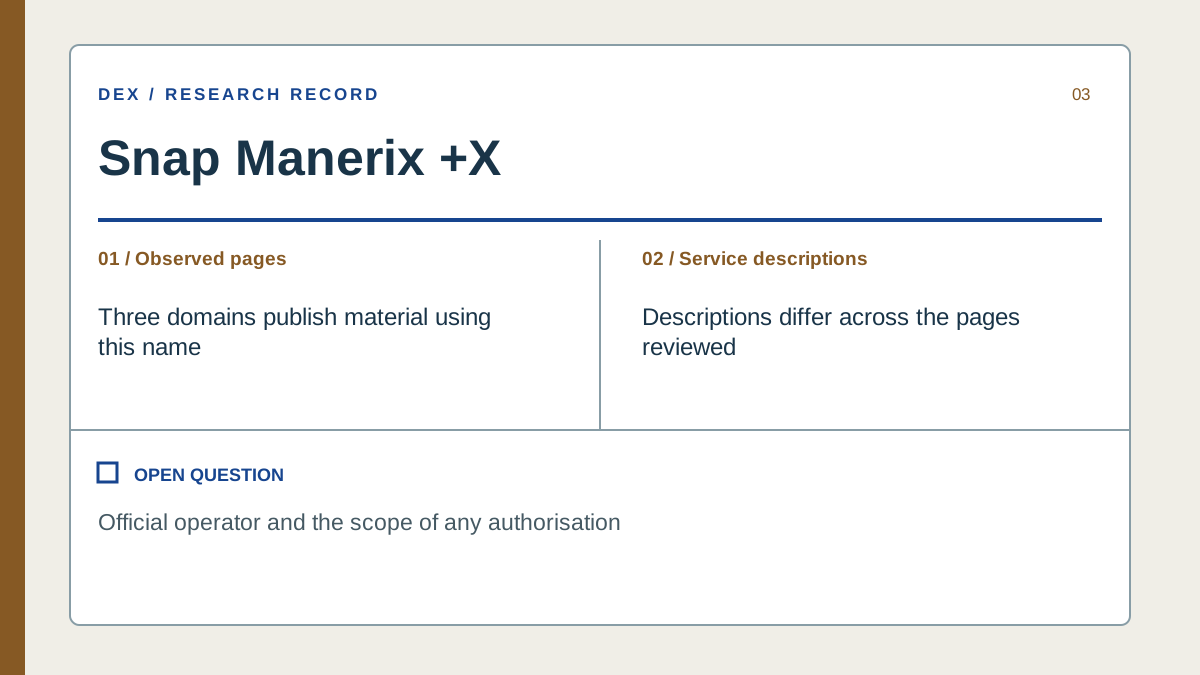
A trading brand advertised online. Nothing in the material available to us identifies an operator, a custodian or a trading venue behind the name.

Application CategoryFinancial Application
Operating SystemWeb

Pros

  • Card payments made to any brand leave a descriptor and a dispute window, both of which are useful
  • No regulator document naming this exact brand reached our desk before the checking date

The points above summarise what the operator says about its own platform. We have not verified them.

Cons

  • The party receiving the deposit is not identified before payment
  • No published policy governs how or when money comes back
  • There is no supervisory body to escalate to, because none is named

Custody: who holds the funds

A merchant account and a custody arrangement are different things, and conflating them is the mistake this entry exists to prevent. A merchant account lets a business accept card payments. Custody is a legal relationship in which an institution holds money for somebody else and owes it back under defined conditions.

A platform can have the first without anything resembling the second. When it does, the money that left a user's bank sits in an operating account, indistinguishable from revenue, and the balance shown on screen is an internal figure with no external counterpart.

We looked for any statement identifying an institution holding funds under this brand and found none. That is the finding for the custody column, and it is the reason every other column on this page matters less than it otherwise would.

What a descriptor does and does not prove

A descriptor can be researched, and it is worth the ten minutes. Searching the exact string sometimes surfaces a payment services business, a company in an unexpected country, or complaints filed by other people about unrelated brands billed the same way. Any of those is information a user did not have before.

What it cannot do is establish authorisation. Accepting card payments requires an agreement with an acquirer, not a licence to handle investments, and the two are granted by entirely different bodies under different rules. A descriptor is therefore a thread to pull, not a conclusion to rest on.

Routing: where an order would go

A trading service either interacts with a market or simulates one. Firms doing the former say where, because their execution policy is a document supervisors expect them to publish and clients are entitled to ask for. Firms taking the other side of client trades disclose that too, since the conflict has to be managed openly.

No venue, liquidity provider or dealing model is disclosed here. The consequence for a user is simple and unpleasant: there is no external price to compare against the one on the screen, so the cost of a trade cannot be measured, only accepted.

The entity behind the terms

Everything enforceable in this business runs through a legal name. Without one, a user has an experience rather than an agreement.

Our search for the company behind Snap Manerix +X returned nothing we could confirm. We do not conclude from this that no operator exists; we conclude that a user cannot identify it either, and that the ordinary tools of recourse, a complaint to a supervisor, a letter before action, a claim in a named jurisdiction, have nothing to attach to.

The licence question

A licence claim is made checkable by three fields: the authority, the number and the exact legal name of the holder. The third is the one that decides the matter, and it is the one most often left out.

The registers themselves are public, free and quick. Searching the company name from the terms rather than the brand from the homepage is the whole technique. If the register returns a different company from the one in your contract, the claim has failed the test regardless of how real the number looks.

We recorded no such claim for this brand, and found no register entry for it.

Deposits and withdrawals

Payment method is the part of this transaction a user still fully controls, and it determines how reversible the decision is. Cards carry scheme dispute rules and deadlines. Bank transfers depend on the cooperation of the receiving institution. Cryptocurrency transfers are final.

Since no withdrawal policy is published for this name, the terms of the exit would be communicated at the exit. Anything a user wants to rely on later should be captured now: screenshots of the deposit page, the exact descriptor, the name and contact details of anyone who called, and every promise made in writing.

One more practical point about timing. Dispute windows run from the transaction date rather than from the day a user realises there is a problem, and that gap is where most opportunities are lost. Anyone who has already paid and has doubts should speak to their bank while the window is still open, instead of waiting to see whether the balance recovers.

Reading the marketing

Two sentences in this kind of promotion deserve particular attention, because they are the ones that sound like disclosure while avoiding it.

The first is any version of "your funds are fully protected" without a named institution or scheme. Protection is a specific legal arrangement with an administrator behind it, and a sentence that omits both is describing a feeling. The second is any claim about technology stated as an outcome, where the mechanism, the data and the period are all missing. Neither sentence can be disproved, which is exactly why neither should be counted as evidence.

A checklist before you fund an account

  • Record the card descriptor from your statement and keep it with your correspondence.
  • Insist on the legal name of the company receiving the money before you send it.
  • Search that name in a company register, then in the register of any regulator being claimed.
  • Ask for the withdrawal policy in writing and read the fee and minimum clauses.
  • Make the first withdrawal small and early, and treat any new fee demanded at that moment as a warning rather than an obstacle.

The order matters. The first two steps cost nothing and settle most cases before any money moves.

Frequently asked questions

What is a card descriptor and where do I find it?

It is the short text next to a charge on your statement, and it identifies the merchant account used to take the payment. It is worth recording because it is often the only concrete identifier a user receives. It does not tell you who holds the money afterwards or whether the merchant is licensed for investment services.

Can I get a card payment back?

Card schemes provide dispute processes with defined time limits, and your issuing bank decides how they apply to your case. The practical advice is to act early and to give the bank the descriptor, the dates and any written promises made to you. We cannot promise an outcome, because the decision belongs to the scheme and the issuer.

Why is this entry marked unverified rather than dangerous?

Because we apply the status to evidence, not to suspicion. A stronger status on this site requires a public regulator document naming the platform, which we did not find. Unverified means the basic facts a user needs are missing, and that is serious enough on its own.

Check it yourself

These registers are public and free. If a platform claims a licence you cannot find here, treat the claim as false.

Written by

Editor, custody and settlement desk

Halvard Ness edits DEX Registry and owns the custody column of every entry: who is said to hold client money, under what account structure, and whether any of it can be confirmed outside the platform's own pages. He writes the entries that turn on a missing custody statement and signs off every verdict before it is published.