Entry

Sensor Celexa Pro: what the dashboard shows and what it proves

Read what Sensor Celexa Pro leaves undisclosed about custody, execution and its legal entity, and see the questions that separate a balance from a claim.

Author Halvard Ness
Published
Last verified

How we make money. We earn a commission on some links on this page. Payment never changes a verdict: platforms carrying regulator warnings are marked as such whether or not they pay us.

What the numbers here are. Win rates, success rates, fees and minimum deposits quoted on this page come from the operator’s own marketing unless we name a register or a regulator’s document as the source. We have not tested any of them and found no independent audit of them.

In this article
  1. Custody: who holds the funds
  2. Routing: where an order would go
  3. The entity behind the terms
  4. The licence question
  5. Deposits and withdrawals
  6. Reading the marketing
  7. A checklist before you fund an account
  8. Frequently asked questions

Ask most people what their trading account is and they will describe the screen: a figure at the top, a chart, a list of positions. That description is accurate about the interface and silent about the thing that matters, which is whether the figure corresponds to money somebody is obliged to give back. Sensor Celexa Pro arrives at this registry as a name without an institution behind it, so this entry is written around that gap rather than around features.

What would Sensor Celexa Pro be holding for you?

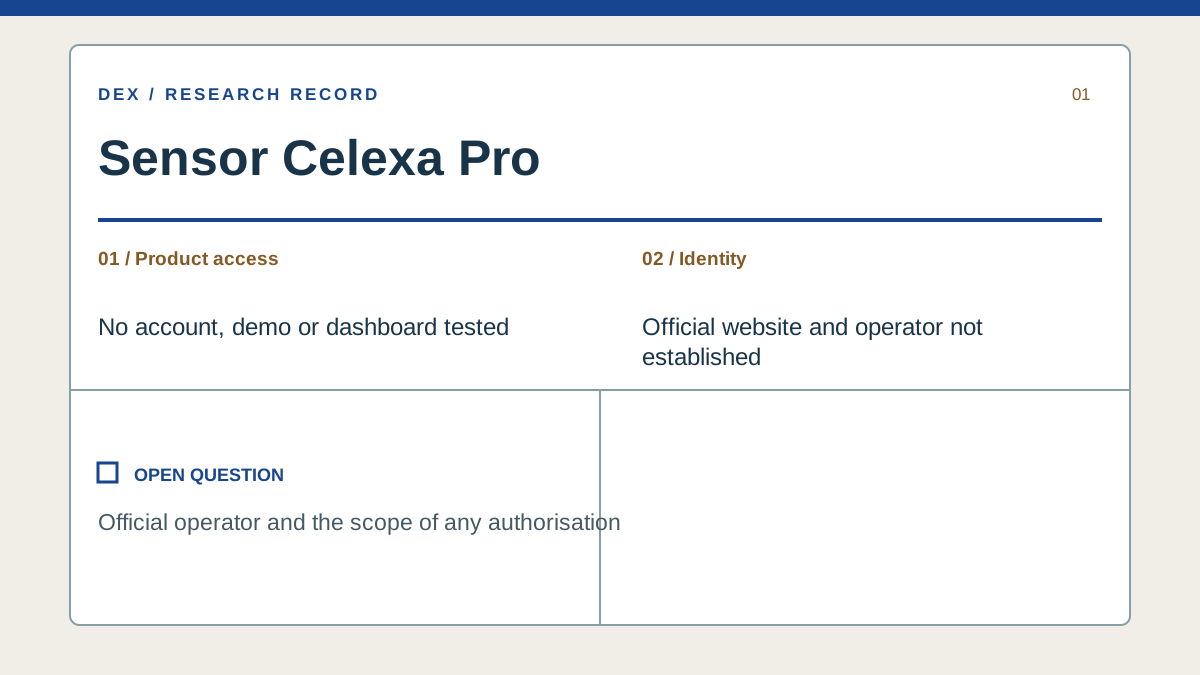
A trading brand circulated online under a compound name. The material available to us describes an interface and an outcome, never an institution, a venue or a company.

Application CategoryFinancial Application
Operating SystemWeb

Pros

  • A brand name this specific is easy to test against a register, which takes about a minute
  • We recorded no published regulator action naming this exact brand as of the checking date

The points above summarise what the operator says about its own platform. We have not verified them.

Cons

  • Money paid in has no documented destination and no named holder
  • Profit and loss shown on screen cannot be reconciled against any external record
  • Support channels, not a regulator or an ombudsman, would be the only route for a complaint

Custody: who holds the funds

Our desk treats custody as the opening question because it is the one that survives every other failure. Software can be rebuilt, a website can move, support staff can change. Whether a bank somewhere is holding money on behalf of clients is a fact that either exists or does not.

The elements of a genuine custody arrangement are few and specific. There is an institution with a name and a licence of its own. There is an account structure that determines whether client money is separable from the operator's money. There is a reconciliation process, usually audited, that checks the ledger against the bank. And there is a rulebook saying what an administrator must do if the operator fails.

For this name we found none of those elements on the record. What replaces them, in this category of platform generally, is the dashboard: a rendered number that behaves exactly as a real balance behaves right up until a withdrawal is attempted.

The test that actually settles it

There is one experiment worth running and it costs the price of a small deposit. Put in a modest amount, let it sit briefly, then request most of it back through the same channel it came in. What happens next is the answer. A platform with real custody returns money mechanically, because moving client funds out is an ordinary operation. A platform without it responds with conditions.

Routing: where an order would go

An order is an instruction that has to reach a market or a counterparty to mean anything. The interesting part of any trading service is therefore the part users never see.

Firms that pass orders to external venues say so, because it is a selling point and in several jurisdictions a disclosure requirement. Firms that take the other side themselves also say so, since that relationship changes what a spread represents and supervisors expect it stated. Silence on this point is unusual among firms doing either, and common among brands that do neither.

We have no disclosed venue, liquidity provider or dealing model for Sensor Celexa Pro. In practical terms this means a user cannot ask whether the quoted price matches the market, because there is no stated market to compare it to.

The entity behind the terms

Registry work is mostly clerical. You open the terms of service, find the sentence naming the contracting party, copy the company number, and search it. The clerical part fails at the first step when no party is named.

That is where this entry sits. We are recording an absence of identification, not an accusation of non-existence, and the distinction matters both for fairness and for the reader's decision. An unnamed counterparty cannot be sued, reported to a supervisor with any precision, or looked up for previous business history. Whoever is on the other side of the agreement, the user is not in a position to know who they have agreed with.

The licence question

Supervisors publish their registers precisely so that this check does not require expertise. Three fields make a licence claim testable: the authority, the reference number and the legal name of the holder. All three have to match, and the match that people skip is the third.

A recurring pattern in this market is a number that resolves to a real, authorised firm with no connection to the brand quoting it. The register lookup succeeds, the user feels reassured, and nothing has actually been verified. Reading the company name that comes back, and comparing it letter by letter with the name in the terms, is the step that turns the check into evidence.

No claim meeting that standard reached us for this brand, and the registers we searched returned no entry for it.

Deposits and withdrawals

Reversibility is the property to think about before payment method convenience. Card payments sit inside a scheme with a dispute process and a deadline. Bank transfers can sometimes be recalled with the receiving bank's cooperation and often cannot. Crypto transfers are final by design.

Because withdrawal terms are unpublished here, a user would learn the rules at the moment they matter least, which is after the money has gone. The sensible protection is procedural rather than technical: keep every message in writing, photograph the deposit and withdrawal screens, and never let an unwithdrawn balance grow past the amount you were prepared to lose on the first day.

Reading the marketing

The copy that surrounds names like this one is built to be agreeable rather than checkable. It tends to describe results rather than mechanisms, to attribute performance to unnamed technology, and to place the reader inside a scene where the decision has already been made.

Our habit is to reduce each promotional page to the small number of statements that could in principle be proved false, then check those. Usually there are two or three, and usually they are the ones the reader skimmed. Everything else is atmosphere, and atmosphere is not a disclosure.

A checklist before you fund an account

  • Find the contracting company in the terms and search its name in a company register.
  • Ask, in writing, which institution holds client deposits and under what account structure.
  • Request the withdrawal policy as a document before making a payment rather than after.
  • Test the exit path with a small withdrawal before the balance means anything to you.
  • Keep records: transaction receipts, chat transcripts and the exact wording of any licence claim.

None of this depends on an opinion of the brand. It depends on documents, and a platform that supplies them has already distinguished itself from one that cannot.

Frequently asked questions

Does a growing balance mean the platform is working?

Not by itself. A balance is a number the operator controls and can display in any state it chooses. The test of a balance is a withdrawal that arrives in your own account, which is why a small early withdrawal tells you more than months of screenshots.

Why does the entity name matter more than the brand?

Because contracts, licences and court proceedings all run on legal names. A brand can be created in an afternoon and abandoned just as fast, while a company leaves a registration trail. If the terms name no company, there is nobody to be bound by them.

What would change this entry from unverified to something else?

A named operating company that appears in a public register, a custody statement identifying the institution holding client funds, or a published regulator document referring to this brand. Any of the three would be recorded here with its source and date.

Check it yourself

These registers are public and free. If a platform claims a licence you cannot find here, treat the claim as false.

Written by

Editor, custody and settlement desk

Halvard Ness edits DEX Registry and owns the custody column of every entry: who is said to hold client money, under what account structure, and whether any of it can be confirmed outside the platform's own pages. He writes the entries that turn on a missing custody statement and signs off every verdict before it is published.