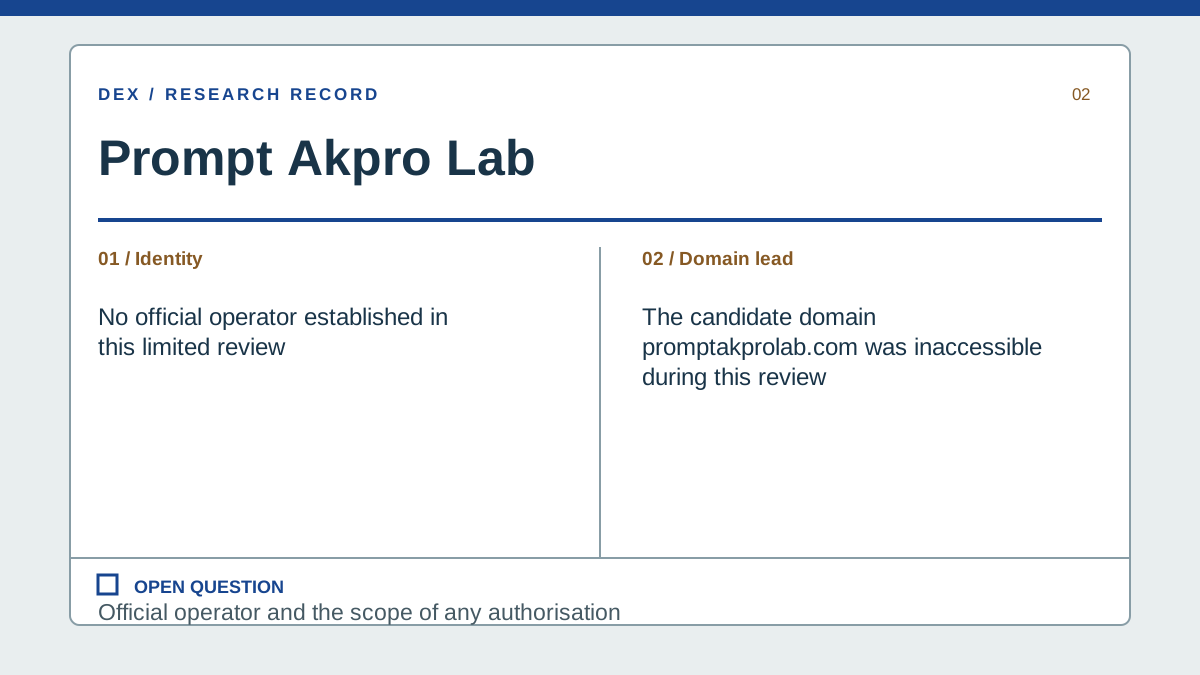
Three words, none of them a financial term. That is the whole of what the name Prompt Akpro Lab tells a reader before any research begins, and it is a fair place for a registry to start, because the marketing is not evidence and the name is all that is certain. This site works through four questions in a fixed order: who holds the money, who fills the order, whose name is on the contract, and which regulator has that name on file. For this entry all four came back empty. An empty column is a finding, and the rest of this page explains what that particular emptiness costs a person who is about to make a deposit.
What is Prompt Akpro Lab supposed to be?
A trading brand promoted online under a compound name. Nothing in the material that reached us identifies the software behind it, the firm operating it or the institution that would hold a deposit.
Pros
- The name is short enough to search, and a register search takes under a minute
- No regulator warning naming this exact brand reached us at the time of checking
The points above summarise what the operator says about its own platform. We have not verified them.
Cons
- No operating company is identified, so there is no counterparty to hold to a contract
- No custodian is named, which leaves the fate of a deposit undefined
- No execution venue is disclosed, so the price a user sees cannot be compared with a market price
Custody: who holds the funds
Custody decides what happens on the day a platform stops answering messages. Everything else, the interface, the charts, the balance on the dashboard, is a representation of money. Custody is the money.
In a supervised brokerage the arrangement is written down and boring. Client funds sit at a named credit institution, the operator is barred from using them for its own obligations, an auditor tests the reconciliation, and an insolvency regime exists for the worst case. Each of those elements can be checked by a person with a browser and ten minutes. None of them attached to this name in any material that reached our desk.
Segregated, omnibus, or unstated
Two structures cover most of the market. Under segregation your balance sits in an account held for clients, distinct from the operator's own money. Under an omnibus structure client balances are pooled into one account in the operator's name, and your claim is a line in the operator's internal ledger rather than a bank record with your name near it. Pooling is legal and common; the problem is not the structure but the silence. A platform that will not say which structure applies to a deposit has answered the question in its own way.
Routing: where an order would go
The second column of a registry entry asks what happens to an instruction after a user clicks. There are three broad answers in this market, and they produce very different outcomes for the same click.
An order can be passed to a regulated venue or liquidity provider, in which case there is a counterparty outside the platform and a price formed by someone other than the operator. It can be internalised, meaning the operator takes the other side, which is lawful in many places and disclosed by firms that do it properly. Or it can go nowhere at all, with the interface simulating fills against numbers the operator controls. The first two are business models. The third is not trading.
Nothing in the material we reviewed says which of the three would apply here. Without a disclosed venue, the price on a screen cannot be compared against an independent quote, and a user has no way to tell a spread from a markup.
The entity behind the terms
Brands do not sign contracts. Companies do. Every enforceable obligation a platform has to a user lives in the name of the legal person written into the terms of service, together with a registered address and a company number.
Our researcher went looking for that name in connection with Prompt Akpro Lab and came back without one. That is the finding, stated plainly, and it is worth separating from a stronger claim we are not making: we are not saying an operator does not exist. We are saying we could not identify it, which means a user cannot either, and a counterparty you cannot name is a counterparty you cannot pursue.
The licence question
Licensing is the one area where the public has genuinely good tools. Registers are free, searchable and updated by the supervisors themselves, and a claim either appears in one or it does not.
A licence claim becomes checkable only when three details are present together: the regulator, the licence number and the exact company name that holds it. Marketing copy often supplies the first, occasionally the second and almost never the third, and the omission is doing work. Numbers belonging to genuine firms are sometimes reproduced beside unrelated brands, so the check that matters is not whether the number exists but whether the register returns the same company that your terms of service name.
We recorded no licence claim for this entry that met all three conditions, and no register search we ran returned the brand.
Deposits and withdrawals
The payment method a platform prefers tells you how reversible your decision is. Card payments run through a scheme with chargeback rules and a defined dispute window. Bank transfers are far harder to recall once settled. Transfers in cryptocurrency are, for practical purposes, final, and a platform that accepts only those has chosen finality on your behalf.
Withdrawal friction has a recognisable shape when it appears: a verification step that arrives only after money is requested back, a fee introduced at the end rather than the beginning, a minimum withdrawal threshold set above the balance, or a support conversation that turns into an offer to deposit more first. None of that is documented for this name, which again is the point. A withdrawal policy you cannot read before depositing is a policy you have agreed to sight unseen.
Reading the marketing
Promotional pages for names of this kind tend to speak in the passive voice about outcomes and in the active voice about urgency. Numbers arrive without a method attached, testimonials without a verifiable person, and the technology is described by adjective rather than function.
The reading habit worth building is mechanical. For every sentence, ask who could confirm it and where. A statement such as "funds are held at a tier one bank" becomes checkable the moment the bank is named and uncheckable while it is not. A statement about accuracy becomes checkable when a method and a period are supplied. Most of the sentences in this category of marketing do not survive the question, which is why the question is worth asking before rather than after a transfer.
A checklist before you fund an account
Five minutes of work, in this order, settles most of it.
- Open the terms of service and write down the exact company name, number and registered address. If no company is named, stop there.
- Search that name, not the brand, in the register of the regulator being claimed.
- Ask support in writing which institution holds client funds and whether accounts are segregated. Keep the answer.
- Read the withdrawal section before depositing: minimums, fees, timelines and the verification documents required.
- Make your first deposit by a reversible method, and request a small withdrawal before adding anything further.
If a platform fails step one or step two, the remaining steps are academic. That is where this entry currently stands, and we will update it if an identifiable entity is put on the record.
Frequently asked questions
Is Prompt Akpro Lab regulated?
We cannot answer that with a yes or a no, and neither can anyone who has not seen the entity behind the brand. Regulation attaches to a company, not to a marketing name, and we found no company named for this brand. Until one is named, the honest status is unverified.
What happens to my money if the platform stops responding?
That depends entirely on the custody arrangement, which is exactly what is missing here. Where client money sits with a named custodian under a segregated structure, an administrator can identify and return it. Where nobody is named, there is no documented process to invoke.
How do I check a licence claim myself?
Take the exact company name from the terms of service, not the brand from the homepage, and search it in the register of the regulator named in the claim. The FCA, CySEC and BaFin registers are free and public. A claim you cannot find in the register it cites should be treated as false.